I have some engineering friends who are serious online gamers. By serious, I mean borderline (or even past the border) PIU. Of course guys who are hardcore gamers are hard to understand, so I thought I’d try, for this assignment at least, to get a taste of what causes this addiction. My friend recommended playing DotA, which stands for Defense of the Ancients. This game is played online between players split into teams. It game is supposedly set in the same universe as WoW (which makes no difference or sense to me).
So when I logged in, the first image that greeted me was the game channel. This showed your friends and their online/offline status. Apparently you can join another game or make your own, and since I was a newbie, I joined someone else’s game. Then I waited for all the slots to be full, in order to actually play the game. There are two sides (aka Good versus Evil) and I picked a Hero to use as my avatar. The goal of the game is to destroy the opposite side’s base, which is a mirror image of my own team’s base.
After all the waiting, the game pretty much started right away. I was very overwhelmed by the pace and action, especially with all the sound effects that came with each attack (I had my speakers on). The terrain itself was pretty simple, consisting mostly of a forest with paths, a river boundary and the team’s bases at the corners. I noticed that there was little chatting going on, unless it was important to the game and when allies warned each other. There was certain lingo that made no sense initially, such as “bot mia” which meant the enemy at the bottom of the screen is missing and might ambush, and “pwn (blank) head for (blank) gold”. The game makes it simple for one to leave at anytime, so there were random departures, especially when the game was shifting more towards one side.
Yee and Bailenson’s study of the Proteus Effect did not really apply to my experience playing this online game. None of the avatars were particularly attractive, and that feature had no impact on the physical game. Also, I chose a threatening-looking Hero with huge blades because I wanted to compensate for my lack of experience. However, I felt no more confident since the game was so overwhelming for a beginner. At the same time, I did feel intimidated by particularly ugly or scary looking avatars chosen by other players but that was because these characters were so alien to me. In this game, size and looks mattered little, compared to the strength and skills characteristics of the avatars. Finally, who I chose did not affect how much I self-disclosed to my fellow team mates. The only conversations going on were based on strategy or some taunting, or in my case, asking for help. Yee and Bailenson’s study would apply more to games in which avatar choice was essential to an online identity, and where online interactions make up the basis of the game.
Comment 1
Comment 2
Monday, November 12, 2007

Assignment 10: Experiencing World of War Craft
The computer-based multi-player videogame that I played over the weekend was World of War Craft. I’ve heard about the game especially throughout this class but I never had an experience playing it. I went home to visit my family and I saw my cousin playing the game. I decided it was a perfect time to kick him off and get some homework done. At first I had no idea what I was doing and it took me a while to get used to controlling the avatar because I had never played a videogame on the computer before. The game space was actually very interesting. It was a complete fantasy world. The area that my cousin helped me get too was a forest. There were trees, grass, little huts where you could find other players, and there were also some evil enemies running around.
Although I did find the environment impressive in terms of graphics, I did not really enjoy the experience I had. I also did not feel that the hypotheses Yee and Bailenson set out in their article, applied to my gaming experience. My avatar was a white tall man with white long hair and a long beard. My avatar travelled on an animal that looked like a big white tiger. Although I was tall and had dominating features, how I interacted with other avatars was not affected. I did not perceive myself to be especially attractive or unattractive. The characters that I stood close to were characters controlled by people my cousin knew. Because my cousin knew them and often played with them, I trusted them. I felt that they would help me out throughout the quest. I also did not disclose much information throughout the game. Perhaps that was because I did not feel that my avatar was attractive. The only time I really spoke to other players was when we were discussing what was going on within the quest. There was not any real conversation about life issues going on. My avatar was also tall. However, this did not affect my confidence. While my avatar was tall, my confidence in the game was actually low because I was a newbie and I was unsure of myself.
Overall, I did not find any of the ideas outlined in Yee and Bailsenson’s article to be true of my gaming experience. I feel that the main reason why this is true is because I was a newbie. I was completely unsure of everything I was doing, so the people I kept close to were the people who I thought would help me. Even though I was tall, I was not confident at all. My conversation also did not include self-disclosure because I was new at the game and I was concentrating more on what was happening on screen with my avatar than disclosing information to strangers or to my cousin’s friends. I feel that many of Yee and Bailsenon’s ideas probably do come up with people who are frequent videogame users, but for someone who is new to it; it definitely takes time (more than 1 hour) to become comfortable with the game. Once you are comfortable with the game and all of the features, then I think you will more likely see some of the correlations between attractiveness and behavior described in the article.
10: Avatars vs. The Self
This week, I entered Second Life as Snn7 Nestler – and I had no idea what I was doing. First, I created an account, and immediately got stuck on the name – in the instructions it said it was important because you couldn’t go back and change it, but I didn’t know what the “norm” was for avatar names. Does one use his/her real name, is it more like a screenname, is it initials? I went with my netid and then chose a last name that was closest to my own. Then I had to choose an avatar and again, I did not know what to do. There were not that many options and none of them really fit my physical attributes. So I went with the young girl with brown hair and some fashion sense.
I began Second Life on Orientation Island with other new users. There was so much going on and I did not know where to begin. I was looking at the instructions and back at the keyboard, totally ignoring the chat window that opened. It was difficult trying to read the instructions, follow them, and pay attention to what other people were doing at the same time. Once I started talking with them, I stopped “playing” and when I was “playing” I had trouble keeping up with their conversation.
I passed the four different stations and received my transport key to Second Life. This time, I was in a world where there were people there specifically to help me and answer my questions. I spent the rest of my hour in this world.
From the beginning, I saw that my avatar choice and other peoples’ avatars affected my behavior. Starting in the orientation world, I was frustrated with my physical appearance because my avatar did not look anything like me and I did not like the idea of people looking at my avatar and connecting it back to me. I was making judgments based on other people’s avatars – I stayed away from the scary looking older man and did not really respond when he started talking to me, but moved myself next to the younger, cute boy and started talking to him – and I didn’t want people make judgments of this avatar who really did not represent who I was. Because I saw myself immediately making these judgments, it made me even more motivated to change my avatar to look like me. I learned how to change my appearance right away and was focused on getting my avatar to resemble me.
The Yee & Bailenson (2007) article was also focused on how avatars and self-representation, questioning how peoples’ avatars change their behavior online. I think for the most part, my avatar choice did not affect the way I behaved in Second Life. According to Yee & Bailenson (2007), “in online environments, the avatar is not simply a uniform that is worn, the avatar is our entire self-representation.” But for me, the avatar was more of the “uniform that is worn” rather than a true self-representation. In the Orientation World, there were three other people with the same avatar because it was just a model you chose to sign up to play. I was uncomfortable with my avatar because I did not like the idea that people were going to interact with me based on what I looked like, yet I looked like so many others in the room.
However, in some ways, I do think that my avatar choice affected my behavior – but not in the ways discussed by Yee and Bailenson. While this study focused on whether one had an attractive or unattractive avatar and how height affected behavior, I was more affected by the fact that my avatar looked nothing like me and a lot like other people in my room. That made me feel uncomfortable, and thus made me more shy and less friendly with the other avatars. The whole time, I was thinking “this isn’t me” and I think it made me less willingly to talk with the other avatars – I didn’t have a sense of self. While I eventually figured out how to change my avatar’s physical appearance, it took me a while to do so and that whole time, I did not have a positive outlook on the situation.
My first experience with the virtual game world online was interesting. I was glad that I finally got to see and experience what I had heard so much about, but at the same time, I did not really enjoy my time in Second Life. I was frustrated that I didn’t know how to play, and learning took time and effort and the avatar’s physical appearance in the beginning. While I can see how people can get very involved in the world and their avatar, for me, I’m more comfortable with FTF interactions and people seeing the real me.
I began Second Life on Orientation Island with other new users. There was so much going on and I did not know where to begin. I was looking at the instructions and back at the keyboard, totally ignoring the chat window that opened. It was difficult trying to read the instructions, follow them, and pay attention to what other people were doing at the same time. Once I started talking with them, I stopped “playing” and when I was “playing” I had trouble keeping up with their conversation.
I passed the four different stations and received my transport key to Second Life. This time, I was in a world where there were people there specifically to help me and answer my questions. I spent the rest of my hour in this world.
From the beginning, I saw that my avatar choice and other peoples’ avatars affected my behavior. Starting in the orientation world, I was frustrated with my physical appearance because my avatar did not look anything like me and I did not like the idea of people looking at my avatar and connecting it back to me. I was making judgments based on other people’s avatars – I stayed away from the scary looking older man and did not really respond when he started talking to me, but moved myself next to the younger, cute boy and started talking to him – and I didn’t want people make judgments of this avatar who really did not represent who I was. Because I saw myself immediately making these judgments, it made me even more motivated to change my avatar to look like me. I learned how to change my appearance right away and was focused on getting my avatar to resemble me.
The Yee & Bailenson (2007) article was also focused on how avatars and self-representation, questioning how peoples’ avatars change their behavior online. I think for the most part, my avatar choice did not affect the way I behaved in Second Life. According to Yee & Bailenson (2007), “in online environments, the avatar is not simply a uniform that is worn, the avatar is our entire self-representation.” But for me, the avatar was more of the “uniform that is worn” rather than a true self-representation. In the Orientation World, there were three other people with the same avatar because it was just a model you chose to sign up to play. I was uncomfortable with my avatar because I did not like the idea that people were going to interact with me based on what I looked like, yet I looked like so many others in the room.
However, in some ways, I do think that my avatar choice affected my behavior – but not in the ways discussed by Yee and Bailenson. While this study focused on whether one had an attractive or unattractive avatar and how height affected behavior, I was more affected by the fact that my avatar looked nothing like me and a lot like other people in my room. That made me feel uncomfortable, and thus made me more shy and less friendly with the other avatars. The whole time, I was thinking “this isn’t me” and I think it made me less willingly to talk with the other avatars – I didn’t have a sense of self. While I eventually figured out how to change my avatar’s physical appearance, it took me a while to do so and that whole time, I did not have a positive outlook on the situation.
My first experience with the virtual game world online was interesting. I was glad that I finally got to see and experience what I had heard so much about, but at the same time, I did not really enjoy my time in Second Life. I was frustrated that I didn’t know how to play, and learning took time and effort and the avatar’s physical appearance in the beginning. While I can see how people can get very involved in the world and their avatar, for me, I’m more comfortable with FTF interactions and people seeing the real me.
#10... I'm moving on from Second Life
After the umpteenth attempt to sign on to Second Life failed, I finally lost it and turned to my own virtual world and went on a killing rampage in which I headshot 3 zombies who have invaded my hospital.
The reason I hesitated to use UrbanDead for this assignment in the first place is that graphics do not have a huge role in the game. The city of Malton is basically a grid of blocks that represent different buildings and streets. Not very exciting.

The game does involve interaction between players (the 3 players controlling the 3 zombies I killed may be unpleasantly surprised when they log on). But there are no avatars to visually represent the players. The game somewhat makes up for this by having a character profile in which you can describe your character's physique, clothing, etc. But still, a written description is very different from a visual avatar.
Therefore I thought UrbanDead was unfit for this assignment. Until I remembered the group forum that I am a part of. The forum provides a more holistic experience to the game because it allows for more player interaction and role-playing. It also helps complete the premises for this assignment: every player has a signature that they display for self-presentation. The signature consists of the player's character's name, rank, activity zone and most importantly, a picture of the character. The picture shows the character's physical appearance and to a large extent, the character's personality by the props (a gun, a syringe, a cigarette, etc) he/she is holding and the posture he/she is taking (swinging an axe, running through fire, etc).
The reason I hesitated to use UrbanDead for this assignment in the first place is that graphics do not have a huge role in the game. The city of Malton is basically a grid of blocks that represent different buildings and streets. Not very exciting.
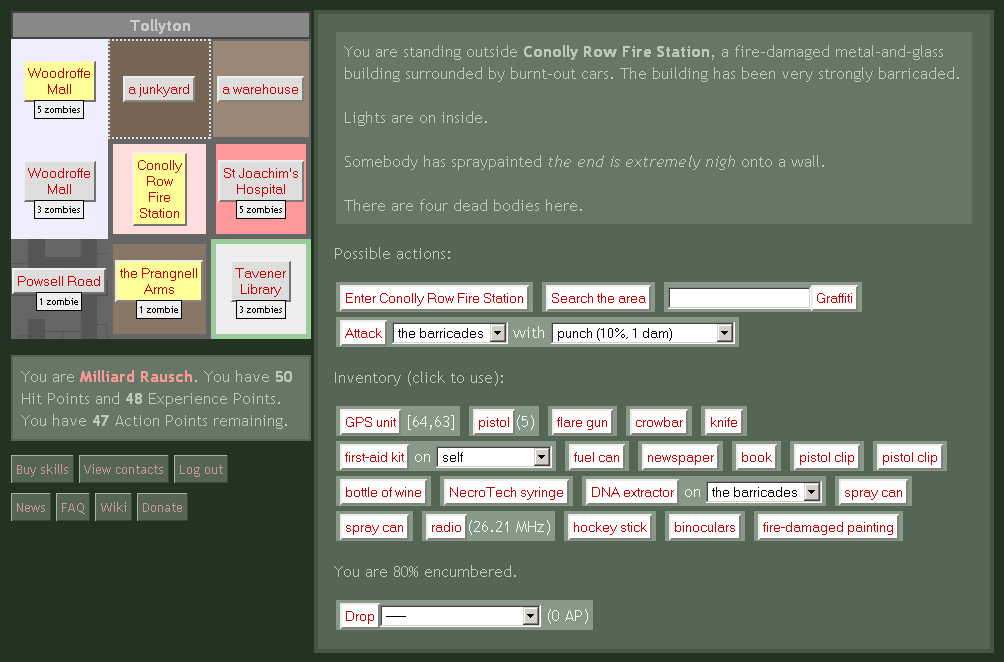
The game does involve interaction between players (the 3 players controlling the 3 zombies I killed may be unpleasantly surprised when they log on). But there are no avatars to visually represent the players. The game somewhat makes up for this by having a character profile in which you can describe your character's physique, clothing, etc. But still, a written description is very different from a visual avatar.
Therefore I thought UrbanDead was unfit for this assignment. Until I remembered the group forum that I am a part of. The forum provides a more holistic experience to the game because it allows for more player interaction and role-playing. It also helps complete the premises for this assignment: every player has a signature that they display for self-presentation. The signature consists of the player's character's name, rank, activity zone and most importantly, a picture of the character. The picture shows the character's physical appearance and to a large extent, the character's personality by the props (a gun, a syringe, a cigarette, etc) he/she is holding and the posture he/she is taking (swinging an axe, running through fire, etc).
The Proteus Effect discussed in the Yee & Bailensen paper is basically behavioural confirmation except it's the self-perception instead of interactions with others that confirms the individual's behaviour. The individual may judge from the point of view of an impartial third party. For example, if my avatar is wearing black, I would think that a third party will think I’m aggressive and unfriendly, and I would subconsciously act more toward that end of the spectrum to match the behaviour I think people will expect from me. Even if I’m wearing black, people may (or may not) still think I’m friendly, but that’s not what my self-perception is telling me. The Proteus Effect tries to exclude the influence of behaviour confirmation from others and focus on the influence of self-perception.
Yee & Bailensen go on to pose the hypotheses that people with attractive avatars will be more friendly and more willing to self-disclose and walk closer to other avatars and that people with taller avatars will be more confident Due to the limitations of the game UrbanDead, I cannot really judge these in the UrbanDead virtual space, but the forum helped greatly, even though interaction in a forum is slightly different. People with clearly defined, attractive pictures in their signatures behave in a more friendly manner and are more willing to engage in role-playing that disclose their personalities. They are also more willing to answer questions others post. People with ambiguous signatures (no clearly defined pictures; face hidden in fire or smoke, etc) have more cut-and-dry posts which mostly relay combat information and contain little or no role-playing.
An interesting phenomenon occurs when people change their signatures to get new, more attractive ones. Their activities in the forum usually increase drastically. They become more open and pleasant as people compliment them on their new signatures. Some of them who have been dormant for a while can even transform into the “center of attention” in some threads.
Because signatures can come in different sizes and not in the same scale, it’s virtually impossible to compare them to determine the characters’ exact height that the players have in mind. One can of course distinguish if a character is meant to be stocky or petite. But accurate comparisons are not possible.
An important thing that Yee & Bailensen mention is choice. In their study, participants didn’t get to choose their avatars. But in real life, players do. Players usually don’t purposefully choose an avatar they perceive to be unattractive. And if they really don’t feel confident with a short avatar, they would simply choose a tall one. This is the case in the UrbanDead forum: everyone designed their own signatures so the signatures should more accurately reflect the way the players wish to self-present.
#10: Looking tough gives you the confidence to be tough
Virtual environments afford the opportunity for players to be whoever they want; female, male, tall, short, pretty, ugly, animal, or human. Yee & Bailenson’s (2007) article discussed their study of the Proteus Effect and how it influenced social interaction in online games. The Proteus Effect explains how an individual’s behavior conforms to their digital self-representation regardless of how others perceive them. This “digital self-representation” is commonly recognized as an avatar, which usually a player can alter and create however they wish. Once a person creates their new self-identity, the Proteus Effect states that the user will “conform to the expectations and stereotypes of the identity of their avatar.” When reading the article I initially thought this was a bit ridiculous, and was skeptical as to how a virtual character could make that much of a difference. However, for this assignment I chose to play Second Life and saw that the effect does in fact often prove to be true.
I have never played a virtual space game before, and it took me a while to get adjusted to Second Life. Once entering the environment, I was put in a circular middle section with different doorways around it leading to different areas. Example of how these different areas were labeled is “appearance” and “communication.” I entered the “appearance” place first because I wanted to change my outfit. Once I entered I had difficulty figuring out how to alter my appearance and I started talking to other players. I was friendly and polite so that they would be willing to help me. The only shirt I could figure out how to change into was a shirt called a “chained shirt.” Once I was wearing it I felt like I looked like an apprentice from the Middle Ages who was learning how to be a knight. I left the building and decided it was time to start interacting with other players and making virtual friends.
I went into an area that was meant to look like a deserted city. There were signs that said “rat crossing” and pretty soon I noticed that there were a lot of rats hanging out in the middle of the street. I felt really alone at first because as I walked around all I saw were deserted cars and desolate buildings. After a few minutes, however, I found a deserted segway and thought it would be really cool to try and ride it. As soon as I walked closer another player came over and I began a conversation by asking if he could help me. He said yes and I started asking how I could change my appearance and if he knew how to drive the machine. He didn’t answer and instead started walking away. Thinking it was a mistake and the person didn’t know how to work the game yet, I started following him, and then the character started running! I ran after him and chased him down three streets. When I was finally close enough I started typing in an angry way saying “HEY! I thought you were going to help me!” I was no longer as polite and friendly as I was to other characters at the beginning. I thought it was pretty funny that I ran after him and spoke so aggressively to him, which is something I would not usually expect myself to do. I began to wonder if it was because I associated my outfit as something a tough knight would wear. Could it be that this “warrior” avatar of mine had encouraged me to act tougher and force someone to stick to their word of agreeing to help me? I hadn’t foreseen myself being unfriendly toward any of the other characters or feeling the need to stand up for myself; after all, once the other player had walked away I could have walked around and found someone else to talk too. As it turns out, the other player then told me he didn’t speak English, so I ended up just walking away and talking to someone else.
I am certain the Proteus Effect can be used to explain my behavior. With other avatars I spoke with I was also very commanding and spoke in a demanding way. I wanted people to answer me and respect me. I originally entered the game thinking I was going to be friendly, polite, and make new friends, but once I changed my clothes and talked to more people I was a lot more aggressive. Yee and Bailenson described how “avatars have a significant impact on how we behave online. Users…may adhere to a new identity that is inferred from their avatars.” Since my clothes made me feel like I was a rough, forceful person, it impacted how I interacted with other characters. I stopped using polite words such as “thank you and please” and even stopped using hedges, which are common for females to use. Just as the article describes someone may become friendlier in an attractive avatar, I became more insistent in my questions and requests of other players. I demanded that they tell me what they had been doing in the game so far and what I was supposed to be doing. I stopped saying hi and asking how people were and instead just started to forcefully speak with them. According to Yee and Bailenson, how players who were taller were more confident when speaking with others. I think this same fact held true for me because my clothes gave me the confidence to act a certain way. Had I been dressed as a princess I may have felt the need to be polite, friendly and subservient to other players. It would be interesting to do this assignment a second time with the rule that everyone has to be the opposite gender. It would be interesting to see how this appearance change affects our behavior too.
comments:
http://comm245purple.blogspot.com/2007/11/10-second-life_13.html
http://comm245purple.blogspot.com/2007/11/my-life-was-so-great-i-literally-wanted.html
I have never played a virtual space game before, and it took me a while to get adjusted to Second Life. Once entering the environment, I was put in a circular middle section with different doorways around it leading to different areas. Example of how these different areas were labeled is “appearance” and “communication.” I entered the “appearance” place first because I wanted to change my outfit. Once I entered I had difficulty figuring out how to alter my appearance and I started talking to other players. I was friendly and polite so that they would be willing to help me. The only shirt I could figure out how to change into was a shirt called a “chained shirt.” Once I was wearing it I felt like I looked like an apprentice from the Middle Ages who was learning how to be a knight. I left the building and decided it was time to start interacting with other players and making virtual friends.
I went into an area that was meant to look like a deserted city. There were signs that said “rat crossing” and pretty soon I noticed that there were a lot of rats hanging out in the middle of the street. I felt really alone at first because as I walked around all I saw were deserted cars and desolate buildings. After a few minutes, however, I found a deserted segway and thought it would be really cool to try and ride it. As soon as I walked closer another player came over and I began a conversation by asking if he could help me. He said yes and I started asking how I could change my appearance and if he knew how to drive the machine. He didn’t answer and instead started walking away. Thinking it was a mistake and the person didn’t know how to work the game yet, I started following him, and then the character started running! I ran after him and chased him down three streets. When I was finally close enough I started typing in an angry way saying “HEY! I thought you were going to help me!” I was no longer as polite and friendly as I was to other characters at the beginning. I thought it was pretty funny that I ran after him and spoke so aggressively to him, which is something I would not usually expect myself to do. I began to wonder if it was because I associated my outfit as something a tough knight would wear. Could it be that this “warrior” avatar of mine had encouraged me to act tougher and force someone to stick to their word of agreeing to help me? I hadn’t foreseen myself being unfriendly toward any of the other characters or feeling the need to stand up for myself; after all, once the other player had walked away I could have walked around and found someone else to talk too. As it turns out, the other player then told me he didn’t speak English, so I ended up just walking away and talking to someone else.
I am certain the Proteus Effect can be used to explain my behavior. With other avatars I spoke with I was also very commanding and spoke in a demanding way. I wanted people to answer me and respect me. I originally entered the game thinking I was going to be friendly, polite, and make new friends, but once I changed my clothes and talked to more people I was a lot more aggressive. Yee and Bailenson described how “avatars have a significant impact on how we behave online. Users…may adhere to a new identity that is inferred from their avatars.” Since my clothes made me feel like I was a rough, forceful person, it impacted how I interacted with other characters. I stopped using polite words such as “thank you and please” and even stopped using hedges, which are common for females to use. Just as the article describes someone may become friendlier in an attractive avatar, I became more insistent in my questions and requests of other players. I demanded that they tell me what they had been doing in the game so far and what I was supposed to be doing. I stopped saying hi and asking how people were and instead just started to forcefully speak with them. According to Yee and Bailenson, how players who were taller were more confident when speaking with others. I think this same fact held true for me because my clothes gave me the confidence to act a certain way. Had I been dressed as a princess I may have felt the need to be polite, friendly and subservient to other players. It would be interesting to do this assignment a second time with the rule that everyone has to be the opposite gender. It would be interesting to see how this appearance change affects our behavior too.
comments:
http://comm245purple.blogspot.com/2007/11/10-second-life_13.html
http://comm245purple.blogspot.com/2007/11/my-life-was-so-great-i-literally-wanted.html
Sunday, November 11, 2007
A Plastic Surgeon's Dream--Second Life and the Modification of Avatar Appearance (10)
I had never heard of the options of games given for this assignment. Just for fun I chose the game Second Life, just because the title sounded interesting to me. After talking to a friend, he described it as similar to The Sims except in an interactive online community. I immediately decided to download and play the game, especially when I found out all the other games had shooting or any other form of coordinating skill (which I lack).
It took me awhile to learn the ropes of Second Life (a whole half hour was wasted trying to figure out how to move). Once I did, I was able to explore the default location to which I was placed which was a welcome center for newbies like myself. The graphics were beautiful, and I liked the background music. I had a few terse conversations with a few of the new members but no significant interaction. I think this is partly because of the avatar choice. Since we were all new to the game, most of us had avatars we didn't customize yet and thus could not reflect our personalities. It wasn't until I learned how to modify my avatars appearance that the real fun began.
There were so many settings to choose from to alter the avatar's appearance. For instance, to modify the nose itself you could choose from a spectrum of narrowing or widening the bridge, nostrils, bulb, tip and vitually every possible part of the nose to create any shape desired. The shape of an avatar's body also had modifications that one could spend hours on fine tuning the body shape they've always wanted. Muscle content, fat content and virtually the entire bone structure of virtually every area of the human body could be altered. For fun I altered my avatar by setting its body weight to one of the highest settings possible and its height to one of the lowest setting possible. After that I proceeded to go to a different location with a Japanese theme. The setting was beautiful with waterfalls and a calming Japanese sounding melody in the background. Under this avatar, I didn't interact with too many people. Instead, I observed other people's behaviors and chat activity outside of the default location.
According to Yee and Bailenson (2007), a person with a more attractive avatar will self disclose and move closer to others than a person with a less attractive avatar. This is an example of the Proteus Effect in which an individual's behavior conforms more to their digital representation than to the forces of behavioral confirmation. I found this to be very consistent with what I experienced when I changed the appearance of my avatar. I significantly lowered the body weight of my avatar and added long brown hair and increased the appearance of make-up. In addition, I reduced the size of my avatar's nose. This had a profound effect on how I began to interact with others.
Immediately, I began to participate in chat conversations when I moved to a room with an Israeli theme. Perhaps it was because I was more comfortable in this room area since I am Israeli, but I approached more people in the room and began to ask about their reasons for their presence in the room. Many people began to talk to me, and I felt as if I was the leader of the conversation, talking about our hometowns, army service and our favorite Israeli food. I self-disclosed a lot of information about my upbringing in Israel and my family that lives there. I also noticed that my distance to others was a lot smaller once I changed my appearance for the better. In the Japan room, I was a free-floater, not getting close to anyone. However when I was in the Israeli room I interacted with 2 or 3 people the entire time, staying in close proximity with them for a period of time.
Although I wouldn't completely say my altered behavior was due to the Proteus Effect (the type of room and my increasing Second Life experience also played a role), I definitely think the Effect played a role on why I was friendlier, disclosed more information about myself, and stayed closer in distance to other people.
It took me awhile to learn the ropes of Second Life (a whole half hour was wasted trying to figure out how to move). Once I did, I was able to explore the default location to which I was placed which was a welcome center for newbies like myself. The graphics were beautiful, and I liked the background music. I had a few terse conversations with a few of the new members but no significant interaction. I think this is partly because of the avatar choice. Since we were all new to the game, most of us had avatars we didn't customize yet and thus could not reflect our personalities. It wasn't until I learned how to modify my avatars appearance that the real fun began.
There were so many settings to choose from to alter the avatar's appearance. For instance, to modify the nose itself you could choose from a spectrum of narrowing or widening the bridge, nostrils, bulb, tip and vitually every possible part of the nose to create any shape desired. The shape of an avatar's body also had modifications that one could spend hours on fine tuning the body shape they've always wanted. Muscle content, fat content and virtually the entire bone structure of virtually every area of the human body could be altered. For fun I altered my avatar by setting its body weight to one of the highest settings possible and its height to one of the lowest setting possible. After that I proceeded to go to a different location with a Japanese theme. The setting was beautiful with waterfalls and a calming Japanese sounding melody in the background. Under this avatar, I didn't interact with too many people. Instead, I observed other people's behaviors and chat activity outside of the default location.
According to Yee and Bailenson (2007), a person with a more attractive avatar will self disclose and move closer to others than a person with a less attractive avatar. This is an example of the Proteus Effect in which an individual's behavior conforms more to their digital representation than to the forces of behavioral confirmation. I found this to be very consistent with what I experienced when I changed the appearance of my avatar. I significantly lowered the body weight of my avatar and added long brown hair and increased the appearance of make-up. In addition, I reduced the size of my avatar's nose. This had a profound effect on how I began to interact with others.
Immediately, I began to participate in chat conversations when I moved to a room with an Israeli theme. Perhaps it was because I was more comfortable in this room area since I am Israeli, but I approached more people in the room and began to ask about their reasons for their presence in the room. Many people began to talk to me, and I felt as if I was the leader of the conversation, talking about our hometowns, army service and our favorite Israeli food. I self-disclosed a lot of information about my upbringing in Israel and my family that lives there. I also noticed that my distance to others was a lot smaller once I changed my appearance for the better. In the Japan room, I was a free-floater, not getting close to anyone. However when I was in the Israeli room I interacted with 2 or 3 people the entire time, staying in close proximity with them for a period of time.
Although I wouldn't completely say my altered behavior was due to the Proteus Effect (the type of room and my increasing Second Life experience also played a role), I definitely think the Effect played a role on why I was friendlier, disclosed more information about myself, and stayed closer in distance to other people.
Perfect 10: How the avatar affects ability
I made the assumption that most of my classmates would be using Second Life for their online game to complete this entry. So I made a choice to play a different game, Tony Hawk's American Wasteland. I had played the game before, a LOT my freshman year, but I'd never played it online, so it was a new experience for me.
What I did was I used the character that I had created for playing in the game itself, the person resembled me for the most part, male guy about 20 years old with jeans and no-shirt but a hat. That's what I look like when I skateboard.
I signed online and it was an interesting interface, a list of rooms and then a list of games currently being run. I joined a couple here and there. When you join, you sit and wait, watching other people's screens until the next game starts. The games can last between 1-10 minutes depending on how long it was supposed to be.
The very first thing I noticed, I was waaaaaay out of the norm. There were people who were devils and midgets and clowns and all sorts of characters, but not a whole lot of normal looking people. but, at the same time, the more outlandish the person looked, the better they were, many to a point that was quite disturbing.
I decided I liked my avatar and stuck with it. I do realize now however, I did not talk as much or as kindly to the people who were not normal human looking. It may have been because they were beating me in the game, or that they were more rude to me, but it is what I noticed.
Yee & Bailenson (2007) studied the effects the avatar a person uses on their own behavior, not necessarily like confirmation bias, but looking specifically at how it affects the person themselves. They found that people who were bigger or more attractive followed stereotypical behaviors like being aggressive or nicer. I think that in the skateboarding game, most of the entertainment came from playing the skateboarding game itself, so some of the importance of what the person displayed was lost. I did try to act a little more normal, but I don't think it was that effective. I think that in order for the Proteus Effect to be effective, there needs to be a stronger emphasis on social interaction than some ulterior motive. I think that the findings from people when they do their blog entries are going to confirm this. Those who played Second Life or another social game will have a stronger effect than those who played Jedi-Knights or World of Warcraft.
What I did was I used the character that I had created for playing in the game itself, the person resembled me for the most part, male guy about 20 years old with jeans and no-shirt but a hat. That's what I look like when I skateboard.
I signed online and it was an interesting interface, a list of rooms and then a list of games currently being run. I joined a couple here and there. When you join, you sit and wait, watching other people's screens until the next game starts. The games can last between 1-10 minutes depending on how long it was supposed to be.
The very first thing I noticed, I was waaaaaay out of the norm. There were people who were devils and midgets and clowns and all sorts of characters, but not a whole lot of normal looking people. but, at the same time, the more outlandish the person looked, the better they were, many to a point that was quite disturbing.
I decided I liked my avatar and stuck with it. I do realize now however, I did not talk as much or as kindly to the people who were not normal human looking. It may have been because they were beating me in the game, or that they were more rude to me, but it is what I noticed.
Yee & Bailenson (2007) studied the effects the avatar a person uses on their own behavior, not necessarily like confirmation bias, but looking specifically at how it affects the person themselves. They found that people who were bigger or more attractive followed stereotypical behaviors like being aggressive or nicer. I think that in the skateboarding game, most of the entertainment came from playing the skateboarding game itself, so some of the importance of what the person displayed was lost. I did try to act a little more normal, but I don't think it was that effective. I think that in order for the Proteus Effect to be effective, there needs to be a stronger emphasis on social interaction than some ulterior motive. I think that the findings from people when they do their blog entries are going to confirm this. Those who played Second Life or another social game will have a stronger effect than those who played Jedi-Knights or World of Warcraft.
Subscribe to:
Posts (Atom)